
Your Non-Toxic Kitchen, Reimagined
You've Made Some Changes. You're Just Not Sure They're the Right Ones.
A 5-Day Reset in How You Evaluate What Belongs in Your Healthy Kitchen
“Wow! Even at 75, Amy Hartshorn’s approach to evaluating everything in your kitchen freed me from needing to research each item. Each video took me to a different part of my kitchen, along with encouragement to evaluate that aspect. Clear, concise, and fun!”
You've made some changes. You've done some reading.
You've swapped a few things out based on what seemed like good information at the time.
But if you're honest, you're not entirely sure the swaps you made were the right ones.
Or, whether the products you chose are actually any better than what you replaced.
“Non-toxic” is on everything now.
“Clean” means nothing. 'BPA-free' turned out to be its own problem.
And the more you look into it, the harder it becomes to know what's real and what's just better marketing.
Without a clear system for evaluating what actually matters and why, every new product, every new study, every scary headline sends you back to the beginning.
You're not building confidence. You're just accumulating more uncertainty.
And that has a cost. It’s not just the time and money that you spent on swaps that may not have moved the needle.
But it’s the low-grade mental weight of never quite feeling settled about something as fundamental as what you're feeding your family.
You don’t have hours to dissect every study or decode every label — and you shouldn’t have to.
This is five days to build a system that makes most kitchen decisions take minutes, not hours.
By the end of five days,
You'll have a kitchen you've actually evaluated, a family eating from materials you understand, and a decision-making system that handles whatever surfaces next.
This is about reducing cumulative exposure in the place your family interacts with every single day.
In Five Days, You Won't Just Have Made a Few Upgrades
You'll have a kitchen you've deliberately evaluated from top to bottom.
You'll know:
Which exposures you've meaningfully reduced
Which materials are appropriate for high heat, and which aren't
Which daily habits compound exposure over time
Which concerns are lower priority
Where "good enough" truly is good enough
Your family's daily contact with food, cookware, and storage won't feel like a question mark anymore. It will be intentional.
You won't be relying on crossed fingers or brand promises. You'll be relying on understanding.
And that changes two things at once.
Exposure decreases where it actually matters.
The mental load drops because decisions stick.
Less contact with questionable materials, less second-guessing.
Not perfection or paranoia, but a kitchen you trust because you understand it.
The goal isn't perfect choices. It's a way of choosing that doesn't cost you your peace of mind every time something new appears.
You're in the Right Place If...
You've made some nontoxic swaps but genuinely aren't sure if you focused on what matters most
You've bought products labeled 'clean' or 'non-toxic' and later wondered if they actually were
You feel like you're on a research treadmill — always reading, never arriving at real confidence
You're navigating pregnancy, perimenopause, or any life stage where what goes into your body feels more consequential than it used to
You're the person in your household who reads labels — and you're tired of not being sure what they actually mean
You're done being influenced by whomever published something most recently
This is not a strict rulebook or a full kitchen overhaul.
There are plenty of those out there, and they evaporate the moment a brand reformulates, new research surfaces, or your life changes.
This is for the woman who wants to stop swapping things out reactively and start making decisions from a clear, reliable system she actually trusts.
What Life Looks Like After
It's a Tuesday and you're at the grocery store. You see something new on the shelf.
Maybe it's a product you haven't seen before, and the packaging makes a few familiar claims.
Six months ago, you would have photographed it, felt vaguely unsettled, and then researched it later.
Or, you would have popped it into your cart and then had buyer's remorse after you got it home and did some more research.
Now you run it through your framework in about thirty seconds.
You either put it in the cart or you don't, and then you let it go.
Not because you stopped caring, but because you finally have a way to decide that makes sense and that you trust.
When a new study comes out, and you know one will, you won't get unsettled.
You won't wonder what you missed. You'll have a filter for it that tells you whether it changes anything for you specifically.
That's the shift: from uncertain to confident. That's what these five days build.
It means you'll stop keeping a running mental tab open about your kitchen.
When you make a choice, it stays made.
It means you'll stop photographing products in store aisles and googling it to find out: "is this okay?"
You'll know how to evaluate it yourself, on the spot, in under a minute.
It means you'll free up the mental bandwidth that's currently running in the background on this.
The low-grade hum of unresolved questions that follows you around without ever quite resolving.
That time and mental space goes back to you.
What You’ll Understand After Five Days
Five focused days. One short video per day — approximately 10 minutes.
Simple written reflections, suggestions, and answer your questions in real time.
Day 1 — What Actually Deserves Your Attention
Not everything carries the same risk, but most advice treats it as if it does. You'll learn the four questions that work as a filter for everything — any product, any material, any new study that surfaces. Once you have them, you'll never have to start from scratch again. You'll see exactly how to rank what matters and what doesn't, applied to real items from a real kitchen.
You leave with: a clear, repeatable lens for prioritizing what actually moves the needle — based on your specific kitchen habits, not someone else's ranked list.
Day 2 — When Heat Changes the Equation
The same material behaves very differently depending on temperature, duration, and what it's in contact with. Heat is where the highest-impact exposures in your kitchen are concentrated — and where the gap between "this seems fine" and "this actually ranks high" tends to be widest. You'll understand what's happening at the material level with your most-used cooking surfaces, so your decisions are based on real conditions, not label claims or someone else's swap list.
You leave with: a clear picture of where heat is creating the most meaningful exposure in your specific kitchen, and the reasoning to evaluate anything new that comes along.
Day 3 — Storage, Time, and the Slow Exposure
Most exposure isn't immediately obvious — it's cumulative and quiet. This day is about what happens after cooking: what your food sits in, what it touches, how long it's there, and what kind of food it is. Time, acidity, and fat all drive chemical migration in ways most people have never considered — and your fridge is often a higher priority than your freezer, which most people have completely backwards. You'll learn where accumulation is actually happening in your everyday storage habits.
You leave with: a simple audit of your storage defaults and the highest-impact places to make changes — without overhauling everything at once.
Day 4 — The Exposures Nobody Audits
This is the category that surprises people most. Not what you cook in or store food in — but the surfaces your food touches every single day that nobody ever thinks to evaluate. The cutting board. The dishwasher cycle running every night. The utensils. The detergent residue. Nothing about these feels urgent, which is exactly how a daily exposure stays invisible for years. You'll see each one run through the framework and understand why daily and habitual is precisely what matters most.
You leave with: a checklist of hidden multipliers in your kitchen and a clear sense of which ones are easiest to address first.
Day 5 — Your Personal Decision Framework
This is where everything comes together. Not a list of rules that expires the moment a brand reformulates or new research surfaces — but a repeatable, personalized way to evaluate tradeoffs that accounts for your physiology, your budget, your lifestyle, and your values. We also talk honestly about what this framework can and can't do, because most nontoxic living content skips that part — and skipping it is part of what leaves people feeling unsettled even after they've done the work.
You leave with: a decision model that doesn't expire. Ever.
Bonus: Live (Recorded) Q&A — Decoding Labels and Spotting Greenwashing
"Clean." "Non-toxic." "Free from..."
These words are everywhere, and they're designed to feel like reassuring answers when they're often just positioning.
Find out the truth about label claims and greenwashing in this bonus video.
The Cost of Staying Stuck
You already know what this cycle feels like…
You find something that seems credible, make a swap, feel okay about it for a while.
Then something new surfaces and you're right back where you started.
You question the decision you made, wondering if the product you chose is actually any safer than what you replaced.
It gets added to the mental list of things you still haven't fully resolved.
Meanwhile, the exposures you're trying to reduce are still there.
The cookware you're not sure about, the containers in the fridge you keep meaning to research.
The food your family eats every single day from packaging you can't quite evaluate.
Not because you don't care but because you've never had a reliable way to know.
In five days you'll walk away with a kitchen you've actually evaluated, not just partially upgraded.
You'll know which exposures you've meaningfully reduced and why.
Your family's daily contact with the materials, packaging, and food that matter most will be something you've made deliberate decisions about, from a place of real understanding rather than best guesses and crossed fingers.
And the stress that's been running alongside all of that — the low-grade hum of unresolved questions about something as fundamental as what your family is eating and what they're eating it from — that goes too. Your body gets relief on both fronts. Less exposure. Less chronic mental load. Those two things together are not a small thing.
Not more to carry. A way to put it down for good.
Lists Tell You What to Buy. This Teaches You How to Decide.
Most programs hand you answers like “use this pan”, “avoid that ingredient”, “buy these containers.”
That works…until a brand reformulates, new research surfaces, your life stage shifts, or your budget changes.
And then you're back to researching from scratch, wondering if the swap you made two years ago still holds up.
A curated list tells you what someone else would choose.
A framework teaches you how to decide, based on your variables, your habits, your real life.
And it's designed to work in a real, busy life, not just in theory.
Lists expire. A decision model doesn't.
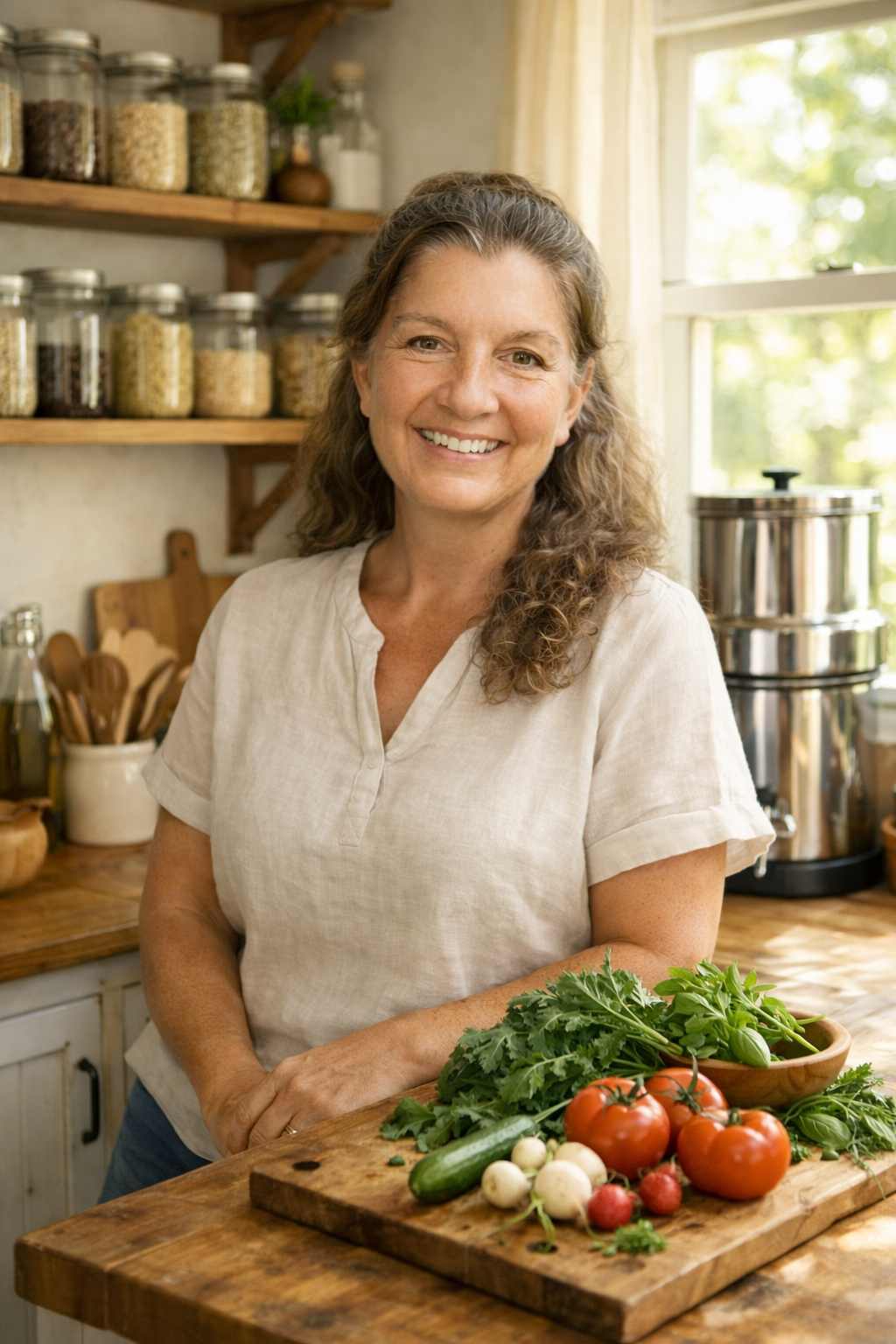
This also comes from someone who lives these principles, not just teaches them.
I co-run an organic farm and have spent over 30 years translating the complexity of clean food and healthy homes into frameworks that actually work in real life.
What you'll build in five days is the same system I use every day.
5 days. 15 minutes a day. Only $147.
Because the framework you build this week will save you
far more than that in swaps you'll never make again.
Why Now
You've been meaning to sort this out for a while. This is the week it actually happens.
What You’re Joining
Five days, 15 minutes a day, only $147.
The framework you build this week will save you far more than $147 in swaps
you’ll never need to make, and in upgrades you’ll realize weren’t necessary.
This Is the Week You Stop Guessing and Start Knowing.
Five days. One framework. No more starting over.
You've already shown you care enough to try. Now let's make sure the trying is aimed at the right things.
You've spent enough time in the cycle. You already know enough to begin.
Questions? Email me here.